
CUT THE RED WIRE FIRST
A Practitioner’s Guide to Maritime Dominance

January 17, 1991. 0300 local. I sat strapped in the cockpit of an A-6E Intruder on the Cat 1 of CV-60 USS Saratoga, watching the catapult crew below run their final checks – as a graceful ballet. The Persian Gulf was pitch black. The flight deck smelled of jet fuel, the high pitch of jet engines became white noise, the deck was slick with oil. My bombardier-navigator had already run his checks on our weapons systems. We both knew what the next six hours would require. No confusion about the mission. No ambiguity about the objective. No time remained before launch — the UN Security Council Resolution #678 demanded Iraq’s unconditional withdraw by November 29th, 1990, the diplomatic window had past and closed, and the decision by President Bush authorizing strikes had been signed. We launched.
I have thought about that moment many times in the thirty-five years since. Not with nostalgia — but instead with resolve that has shaped my career and solidified my character.
In the bombing business, the irreducible challenge is this: the weapons are live, the clock is running, and the team must act with the information available — not the information they wish they had. Hesitation is not caution. Hesitation is a choice. In a room full of people debating which targets to strike, the mission does not wait for consensus. That lesson was true over Baghdad in 1991. It was true over Kosovo in 1999. It has been confirmed in every conflict since. And it is certainly true today — not in a cockpit over the Persian Gulf, but in the policy offices and program shops and acquisition corridors where the next war is being won or lost before a single weapon is fired.
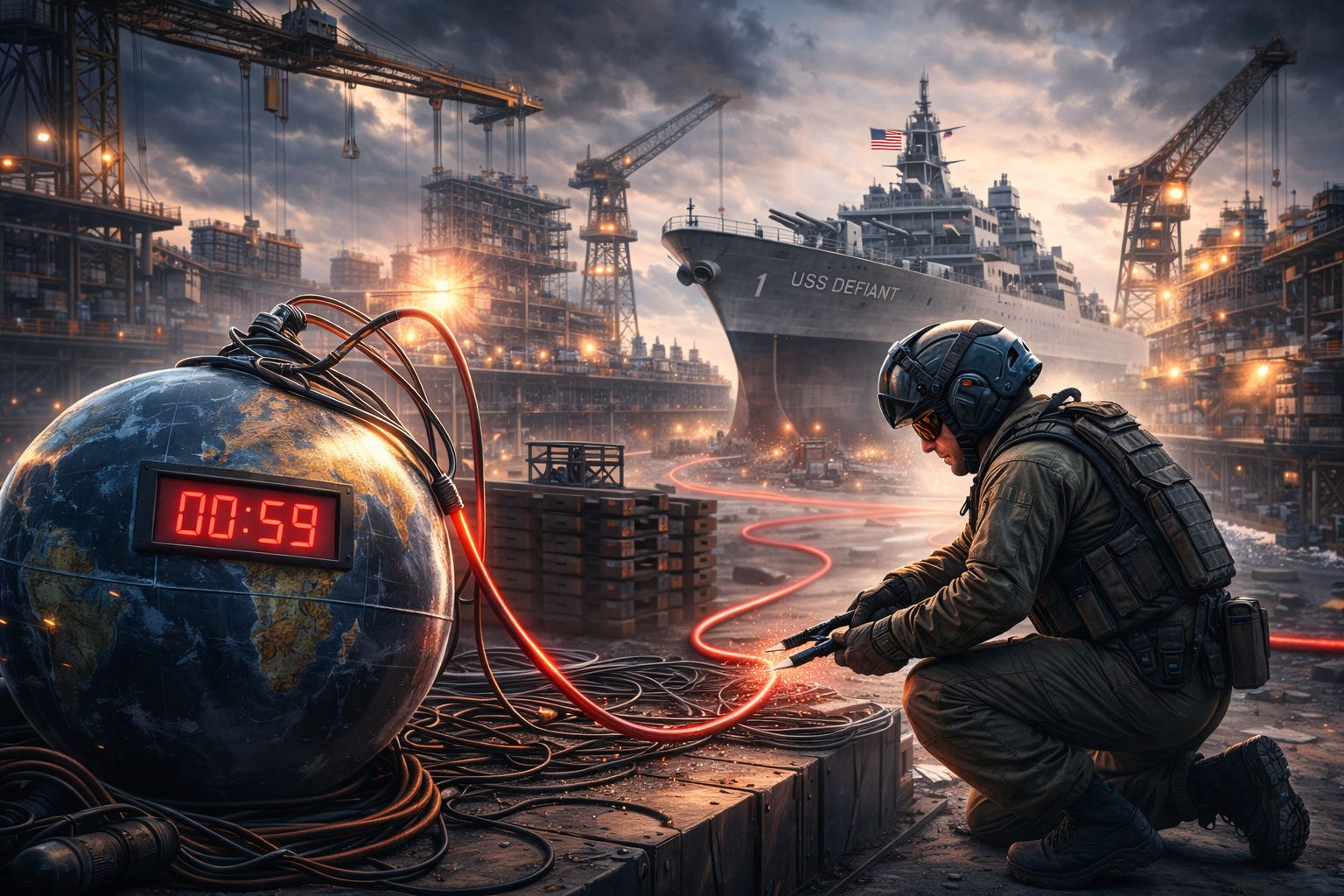
The metaphor that best describes our current predicament is not the resolute bombing mission thirty-five years ago but rather the global bomb defusing challenges our nation faces today. In the air, the decisive act is precisely striking the target on the ground. On the international stage, the decisive act is severing the connection between the power source and the detonation — identifying which wire, and with a hand steady, cutting that wire before the global clock (threat) runs out. These two disciplines share the same irreducible demand: preparation that precedes the moment of decision, clarity about what must be done, and the will to act when hesitation would be lethal. The difference is that in bomb disposal, the objective is not destruction. It is prevention of an explosion. You are not trying to hit something. You are trying to stop something that is already armed and dangerously close to going high order.
That is where the United States stands today on maritime dominance. The international threat is fully armed – whether it is the Strait of Hormuz or the Taiwanese Strait. The clock is running. The decision is identifying which wire to cut.
As I write this, the nation’s attention is fixed on Operation Epic Fury — the coordinated U.S. and Israeli campaign launched on February 28, 2026 against Iranian missile infrastructure, nuclear sites, and naval assets. The first 100 hours alone cost an estimated $3.7 billion in munitions. In the opening days, Iran fired more than 500 ballistic missiles and approximately 2,000 one-way attack drones. American Patriot and THAAD interceptors engaged in volume. The exchange ratio was effective operationally but unfavorable economically at every intercept tier for ballistic threats — Iran expending missiles that cost a fraction of the interceptors required to stop them, while U.S. production timelines for those interceptors’ run orders of magnitude longer than Iran’s magazine depth. By mid-campaign, U.S. forces had shifted from high-cost standoff cruise missiles to JDAM precision kits — not by preference, but because the arithmetic of sustained operations compresses options. This is the exact industrial mathematics I described in these pages two weeks ago in “The Arithmetic of War.” Every interceptor fired is one less in the magazine. Every day of sustained high-tempo operations reveals whether the industrial base behind the force can regenerate faster than the force is expended. In Iran, with a regional adversary of limited industrial depth, the answer has been a resounding yes — so far.
Now apply that same arithmetic to China. The People’s Liberation Army Rocket Force commands over 2,850 ballistic missiles with annual production measured in the thousands, not hundreds. A Taiwan scenario would not open with 500 missiles over nine days. It would open with salvos of a thousand or more in the first hours, sustained and regenerated by an industrial base that dwarfs anything Iran has ever fielded. The interceptor math that strained American magazines over Iran becomes a strategic catastrophe against China. The lesson of Epic Fury is not that America can manage peer-level attrition. It is that America cannot — and that the time to fix the industrial foundation is now, while the conflict is in the Middle East and not the Pacific.
On April 9, 2025, President Trump signed Executive Order 14269, Restoring America’s Maritime Dominance. On February 16, 2026, the White House released the Maritime Action Plan — a 42-page blueprint organized around four pillars, coordinated across six cabinet departments, and signed by the National Security Advisor and the Director of OMB. The diagnosis is in the document. The architecture is on the page. The resources are being debated. And the clock that has been running for the past four decades — the clock that counts down America’s maritime industrial irrelevance against China’s accelerating supremacy — did not pause for the publication ceremony, and it will not pause for Epic Fury.
It is time to cut the (red) wire.
The clock is not metaphorical. It is ticking toward 2027 — the so-called Davidson Window, when Admiral Phil Davidson warned that China may have both the intent and the capacity to seize Taiwan by force. Xi Jinping has stated publicly and repeatedly that “China will surely be reunified.” Chinese shipyards are launching vast new platforms at a pace no American yard can match. Missile inventories are swelling. Beijing is building a wartime command center reported to be fifty times the size of the Pentagon. Secretary of War Pete Hegseth warned in 2025 with unmistakable clarity: China is building, training, and rehearsing for the real thing. The question is no longer whether the threat is real. The question is whether America can respond in time. The Davidson Window is closing, and delay is not caution — it is a decision in favor of the adversary.
THE ARITHMETIC OF DECLINE
Let me give you the numbers without softening them, because the numbers are the argument.
During World War II, the United States built 286,000 aircraft, 86,000 tanks, 8,800 naval vessels, 2.6 million machine guns, and 41 billion rounds of ammunition. We called it the Arsenal of Democracy. It was not merely a slogan. It was an industrial strategy that produced victory by outbuilding every adversary, absorbing losses, and regenerating combat power faster than it could be destroyed.
Today, the United States builds less than one percent of the world’s commercial ships. China builds ~50 percent. Zero percent of the containers that move goods across global oceans are built in the United States. China builds 96 percent. Zero percent of the ship-to-shore cranes operating in American ports are built domestically. China builds 80 percent. We have 66 total shipyards — eight capable of building vessels over 400 feet in length. The People’s Liberation Army Navy has already surpassed the U.S. Navy in fleet size, reaching beyond 370 battle force ships against our 295, and is projected to reach 425 ships by 2030. The China State Shipbuilding Corporation produced more commercial tonnage in a single year than the United States has managed since the end of World War II.
This is not a trend line. It is a strategic verdict rendered by four decades of decisions — or more precisely, four decades of indecision. Annualized appropriations that prevented multi-year production commitments. Stop-start procurement cycles that denied yards the demand signal to invest. Requirement processes so bureaucratically labored that platforms arrived late, over budget, and operationally compromised before their keels were laid. While America debated requirements documents, China built ships. While our program offices exchanged draft versions of capability development documents, the People’s Liberation Army Navy launched three major modern warships in a single day.
The maritime situation is not an acquisition failure. It is the consequence of treating shipbuilding as a peacetime procurement activity rather than a standing warfighting capability. That distinction carries enormous implications for how we respond.
The evidence is not abstract. The Navy has spent decades producing exquisite weapons at astronomical cost and glacial pace. Littoral Combat Ships — christened by sailors as “Little Crappy Ships” — delivered at cost overruns that dwarfed their tactical value. Zumwalt-class destroyers at eight billion dollars apiece. Gerald R. Ford carriers at thirteen billion dollars, years late to fleet. The F-35 program one hundred billion dollars over budget before a single operational aircraft was delivered to a combat squadron. These are not outliers. They are the predictable output of a system optimized for process compliance and requirements validation rather than mission delivery at speed. The system rewards avoiding risk. It punishes seizing opportunity. And in doing so, it has consistently delivered too little, too late, at too great a cost.
Business theory illuminates why this is so structurally difficult to change. Clay Christensen’s Innovator’s Dilemma explains precisely why incumbents double down on sustaining innovations — incrementally improving existing systems at ever-increasing cost — while systematically ignoring disruptive threats that do not fit their existing frameworks. His “Jobs to be Done” theory reframes the central question: what does the warfighter actually need to accomplish the mission, rather than what does the acquisition system know how to build? In the military context, the warfighter’s mission outcome is the only metric that matters. Everything else is overhead. The Future-Back approach — envisioning the capabilities that tomorrow’s threat environment demands, then working backward to define what must be delivered today — is the planning discipline the Maritime Action Plan implicitly requires and explicitly lacks.
History has delivered the same warning with remorseless consistency. General Billy Mitchell proved the battleship obsolete through air power demonstration and was court-martialed for saying so publicly. France invested a generation of national treasure in the Maginot Line and was outflanked in six weeks. Britain clung to capital ships at the moment carrier aviation was rendering them strategically irrelevant. Dominant powers that fail to adopt disruptive technologies in time do not merely fall behind — they are defeated. Incumbents, in war as in business, rarely disrupt themselves. They are subsequently beaten by those who will.
A BLUEPRINT FOR SUCCESS
More than twenty years ago, VADM Arthur Cebrowski and I authored the charter for the Office of Force Transformation (OFT). President Bush and his Secretary of Defense Donald Rumsfeld had identified the same fundamental problem that confronts us today: the United States military was procuring platforms at the pace of peacetime institutional comfort rather than at the pace of operational necessity. If OFT was his answer, VADM Cebrowski was its mortal soul.
I was fortunate to serve as a program executive for three of OFT’s most consequential programs. I will describe them briefly — not to claim credit, but because they are the existence proof that what the Maritime Action Plan demands is actually achievable. We have done it. We know what it requires.
The first was STILETTO. We delivered the nation’s first large-scale all-carbon fiber stealth vessel to the Department of Defense in 15 months for under $25 million. STILETTO was not merely a hull. It was the first vessel built around an open-architecture digital backbone capable of commanding and controlling large numbers of autonomous and semi-autonomous systems — a concept that was visionary in 2004 and is now the foundation of distributed maritime operations. Twenty-one years later, STILETTO continues to operate at one-tenth the maintenance cost and one-fifth the operating cost of the decommissioned Mk-VI Special Operations vessel it made obsolete. Fifteen months. Twenty-five million dollars. One small team of ~ 20. Zero tolerance for delay.
The second was Operationally Responsive Space. I wrote the first contract to a then-obscure company named SpaceX, authorizing the Falcon-1 as America’s first tactically responsive space launch vehicle. At the same time, we delivered the nation’s first Tactical Microsatellite in less than a year for under twelve million dollars. ORS grew from a ten-million-dollar initiative to a four hundred million dollar program that is now an integral part of the United States Space Force. What began as an idea in a small OFT office is today a national strategic asset.
The third was ZEUS-HLONS — the nation’s first high-energy laser directed energy weapon fielded to clear surface mines and unexploded ordnance from supply routes. Directed energy was not a laboratory exercise. It was a deployed operational capability, delivered at speed, under budget, and ahead of the institutional timeline that a conventional acquisition process would have imposed.
Three programs. Three domains. Twelve months each. All under budget. All operationally consequential. All built by small teams empowered with real authority and held to real accountability – the delivery of an operational capability in 12 months – within a Congressional budget cycle. OFT was, in VADM Cebrowski’s words, a DO tank — not a think tank. The Maritime Action Plan is asking for the DO tank approach at national scale. The question is whether we have the organizational courage and more importantly the leadership to execute it.
WHAT MAP GETS RIGHT — AND WHERE IT IS THIN
The Maritime Action Plan (MAP) deserves honest assessment from a practitioner — not bureaucratic congratulation, and not reflexive cynicism. I will offer both.
The MAP gets the diagnosis exactly right. It acknowledges that America’s shipbuilding industrial base has atrophied to near irrelevance through a combination of government neglect, regulatory overburden, inconsistent demand signals, and a failure to treat the maritime industrial base as a warfighting capability. The MAP correctly identifies that this is a whole-of-government problem requiring whole-of-government solutions — engaging the Department of State, Commerce, Defense, Transportation, Homeland Security, and the Office of the United States Trade Representative in coordinated action. That alignment, if sustained, represents a genuine departure from the fragmented departmental efforts that have characterized the past two decades.
The MAP’s four pillars are logically sound. Rebuilding shipbuilding capacity through infrastructure investment, multi-year contracting, and Maritime Prosperity Zones addresses the supply-side constraint. Reforming workforce education through USMMA modernization and state maritime academy expansion addresses the labor pipeline. Protecting the industrial base through strengthened preference requirements, procurement reform, and Section 301 actions against China’s state-subsidized shipbuilding addresses the competitive threat. The national security pillar’s explicit prioritization of robotic and autonomous systems is the most forward-looking element of the document — and the one most likely to be under-resourced.
Where the MAP is thin, however, it is conspicuously thin. The document correctly acknowledges a serious shipyard labor shortage but provides no immediate mechanism for solving it — no vocational training surge, no immigration pathway for skilled trades, no executive order enabling the kind of civilian industrial mobilization that we practiced in the 1940s. The MAP concentrates on boosting output and capacity but gives limited attention to next-generation maritime technologies: green propulsion, vessel automation, digital shipyard infrastructure, and the AI-driven design tools that allied nations are already deploying at scale. And perhaps most critically, the MAP is organized around plans, studies, and proposals — not around immediate, accountable, time-bound execution with named leaders and measurable outcomes.
Every reform in the MAP depends on the one thing the document cannot legislate: the institutional courage and leadership capacity to move at the speed of the threat rather than the speed of the process.
JCIDS IS DEAD — BUT THE CULTURE IS NOT
On August 20, 2025, Secretary of Defense Pete Hegseth and Deputy Secretary Steve Feinberg signed a memorandum that should have generated front-page coverage in every defense publication in America. By that document, JCIDS — the Joint Capabilities Integration and Development System — was formally disestablished. The JROC was stripped of its validation powers. In its place, three new structures were established: the Requirements and Resourcing Alignment Board, the Joint Acceleration Reserve, and the Mission Engineering and Integration Activity. The goal is radical in its simplicity: align money, mission, and experimentation in real time.
For two decades, JCIDS smothered innovation through layered processes and endless validation cycles. While America debated requirements, adversaries were fielding hypersonic weapons, unmanned platforms, and electronic warfare systems at lower costs, faster pace, and higher volumes. JCIDS did not merely fail. It actively degraded our competitive position in the very domains that will decide the next war.
Killing JCIDS was necessary. It was also, as I wrote at the time, the easy part.
The harder challenge is organizational culture. The Pentagon’s bureaucracy has outlasted every reform since the Packard Commission. Rumsfeld’s transformation agenda was absorbed and neutralized. The Office of Force Transformation produced genuine, operationally significant results — and was quietly dissolved after VADM Cebrowski’s death, its programs eventually absorbed into the same institutional structures they were designed to circumvent. The Army refused to produce mine-resistant vehicles when IEDs were killing soldiers daily, insisting that an up-armored HUMVEE was adequate and that the Joint Light Tactical Vehicle would arrive in a decade. That organizational satisfaction cost lives. It always does.
But before the cynics use that history to argue that nothing changes, they should look at what the programs OFT actually delivered have become. The contract we wrote to SpaceX for the Falcon-1 — at the time a bet on an unknown startup with an unproven rocket — was the first revenue the company ever received from the United States government. Today, SpaceX is not merely a launch provider. It is the launch market. In 2024, SpaceX completed 138 missions, more than all other launch providers on earth combined, accounting for over half of all global orbital launches and delivering 84 percent of all satellite mass to orbit for the year. In 2025, SpaceX executed 165 launches — roughly 52 percent of the 315 orbital launches conducted globally, outpacing the entire rest of the world’s combined launch activity. The Falcon 9 has achieved a 99.4 percent mission success rate across hundreds of flights. The company carries a valuation exceeding $350 billion and is projected to generate $19 billion in revenue in 2025 alone. It is responsible for 80 percent of all U.S. space launches and operates the Starlink constellation that now constitutes 65 percent of all operational satellites in orbit. We did not invest in SpaceX. We ignited it. A single OFT “venture” contract to a then-marginal company, written by a small team with a clear operational requirement and the authority to act on it, created the most consequential space launch enterprise in the history of the United States.
STILETTO tells the same story from the waterline. Twenty years after her delivery, STILETTO continues to operate without having missed a single operational experiment across two decades of continuous service — a reliability record that has no parallel in the modern U.S. naval inventory. She operates at one-tenth the maintenance cost and one-fifth the operating cost of the decommissioned Mk-VI Special Operations vessel she made obsolete, at a total lifecycle cost so far below conventional maritime expectations that program managers who encounter the numbers for the first time assume they are looking at a typo. She was built in 15 months. She costs almost nothing to operate. She has never failed a mission. In maritime circles, those numbers are not merely impressive. They are, quite literally, unimaginable under the conventional acquisition model that governs every other vessel in the fleet. The institutional structures that absorbed OFT did not improve on STILETTO. They never built another one.
This is the essential truth that the reform skeptics cannot answer: when the DO tank model is applied with genuine authority, real accountability, innovative leadership and protection from bureaucratic interference, it produces results that the conventional system cannot match and cannot explain. The failure has not been the model. The failure has been the institutional refusal to sustain it.
The Resource Alignment Board (RRAB), Joint Acceleration Reserve (JAR), and Mission Engineering and Integration Activity (MEIA) will succeed or fail on the same axis as every previous reform: whether the leaders placed in charge of these structures have real authority, real accountability, and real protection from the institutional antibodies that have neutralized every previous attempt. Those antibodies — the program offices protecting existing Programs of Record, the appropriations staff defending baseline budgets, the flag officers prioritizing platform survival over mission effectiveness — did not retire when JCIDS was disestablished. They are already repositioning.
The Maritime Action Plan needs the same honest reckoning. The MAP can establish Maritime Prosperity Zones and authorize multiyear contracts and direct the Army Corps of Engineers to assess shipping channel depths — and all of that is useful and necessary. But unless the execution is managed by empowered leaders with timelines measured in months rather than fiscal years, the MAP will be remembered as another comprehensive plan that produced another set of comprehensive reports.
THE CUT WIRE REQUIRES A STEADY HAND
I want to be precise about the metaphor, because it matters.
In bomb disposal, the wire is not the bomb. The wire is the enabling mechanism — the connection between the power source and the detonation charge. Cut the wire, and the bomb is inert. Leave the wire intact, and the most sophisticated bomb squad in the world cannot prevent the explosion.
In the maritime dominance challenge, the wire is the acquisition system and those who are incapable of delivering on the President’s Executive Order. Not any single program. Not any single budget line. The wire is the accumulated set of processes, approval authorities, meritless leaders, and political hacks, using requirements validation cycles, design change authorities, and contracting mechanisms that determine how fast the United States can translate national will into operational capability.
But cutting the wire is not enough. The wire requires a steady hand. And a steady hand is not the product of good intentions or financial acumen alone. It is the product of a specific and non-negotiable combination: operational experience earned in uniform, technical mastery deep enough to interrogate a program office without being deceived, and business discipline hard enough to hold industry accountable to cost and schedule rather than accept the chronic renegotiation that has defined every major Navy shipbuilding program of the past generation.
That combination is not common. It is not produced by investment banking, portfolio management, or philanthropic board service — however distinguished. It is produced by decades of compounded experience across all three domains simultaneously. It is the difference between a leader who can read a briefing about ship construction delays and a leader who knows, from years of direct experience, precisely which slide in that briefing is obscuring the real problem and why the program manager presenting it is hoping you will not ask the follow-up question.
Consider what that formation actually produces. Imagine a leader who first learned precision under fire — in a combat cockpit, in six different conflicts across two decades, where the consequence of error was measured not in contract penalties but in lives. Who learned systems at the level of the physicist, studying rocket propulsion and laser optics not as policy concepts but as engineering disciplines, because the weapons he would later field demanded that depth of understanding. Who then sat across the table from a Secretary of Defense and was handed three programs and a mandate: deliver something the military has never had, in twelve months, for less than it has ever been done. And did. Three times. Across three domains. Then spent nearly two decades running a company — not advising one, not investing in one, but building one from nothing, winning and delivering hundreds of contracts on merit, manufacturing hardware that had to work in the field rather than in the briefing room, and doing so at a level of process discipline that the Department of War uses to certify the most rigorous engineering organizations in its industrial base. And who, having done all of that, returned to teach the next generation of naval officers at the institution that had taught him. That formation — the convergence of operational credibility, technical depth, and executive accountability — is what produces a leader who can look at a live wire, know which one needs to be cut, and with a firm hand – hold steady in the moment of cutting.
Now consider what the Department of the Navy is currently asking to execute the Maritime Action Plan — an agenda that will require overseeing ~$260 billion USD in overall annual budget and making milestone decisions on every major naval platform the United States will depend on for the next thirty years. The 79th Secretary of the Navy arrived in office in March 2025 as a private equity investor — the co-founding partner of a firm managing Michael Dell’s capital and the founder of a Palm Beach investment company. No military service. No defense industry experience. No engineering background. No shipbuilding knowledge. No acquisition experience. The first civilian to lead the Navy without military service since 2006. A genuine commitment to reform, acknowledged openly at his confirmation hearing — and a credential gap that is equally open and equally consequential. His own Senate confirmation exchange captured the tension precisely: one senator noted that his nontraditional background was acceptable, so long as the traditional approach was not working. It has not been working. But the question of whether a different kind of nontraditional background is the right correction is one the Maritime Action Plan cannot afford to get wrong.
The Assistant Secretary of Navy Research, Development and Acquisition (ASN (RDA)) — the Navy’s acquisition executive, the official who serves as Program Decision Authority on every major naval acquisition, the officer responsible for the research, development, and procurement of every ship, aircraft, weapon, and autonomous system in the Navy and Marine Corps — is currently being performed on an acting basis by a career civil servant, with no Senate-confirmed appointee in place, and no technical degree nor business acumen. The position overseeing ~$90 billion in annual obligations and ~150,000 people is, as of this writing, not filled. This is not a bureaucratic footnote. It is a strategic vulnerability. You cannot cut the wire with an acting hand.
The MAP cannot succeed at the speed required unless the wire is cut. Multi-year contracts mean nothing if program offices can unilaterally impose late-stage design changes that reset delivery schedules. RRAB and JAR mean nothing if the Defense Acquisition System’s cost-estimating and milestone review processes remain unchanged. Commercial off-the-shelf solutions mean nothing if the FAR compliance requirements make commercial vendors unwilling to engage. Maritime Prosperity Zones mean nothing if environmental review timelines for shipyard expansion run to a decade.
The FAR overhaul announced in August 2025 — the most significant reform to federal commercial buying procedures in over forty years — is the most important single acquisition reform of this generation. If fully implemented, it could do for the maritime industrial base what the commercial-first acquisition approach did for Operationally Responsive Space: open the field to vendors who build ships faster and at lower cost than the traditional defense industrial base, because they are not burdened by its overhead.
The Executive Order was right to direct DoD, Commerce, and Transportation to identify and roll back unnecessary regulations. The Navy’s establishment of the Deputy Assistant Secretary for Robotic and Autonomous Systems and the Naval Rapid Capabilities Office in 2025 are exactly the right structural moves. What these organizations need now is not more organizational charts. They need program executives with the same mandate VADM Cebrowski gave us in 2003: deliver something operationally consequential in twelve months. If you cannot, explain why. If you can explain why, fix it. If you cannot fix it, find someone who can.
WHAT VICTORY AT SEA ACTUALLY REQUIRES
I want to describe what maritime dominance looks like in practical terms, because the MAP’s four pillars, while correct in direction, can become abstract in execution.
Victory at sea in a conflict with a peer competitor will not be determined by the size or sophistication of the fleet at the start of the conflict. The 2025 National Security Strategy is explicit on this point, and it is correct: attrition is no longer an exception in peer competition. It is the central condition of war. Traditional assumptions — technological overmatch, fleet survivability through concentration, post-conflict industrial recovery — no longer hold. The future fleet must be designed not to avoid loss, but to absorb loss and regenerate faster than an adversary can destroy – that is the very definition of attritable – “platforms that can be built faster than can be destroyed.”
This reframes the entire strategic problem. We are not building a fleet. We are building a national regenerative capacity. The shipyards are not a procurement function. They are a warfighting asset, measured in throughput, surge capacity, and replacement velocity. The workforce pipeline is not a labor market challenge. It is a readiness requirement.
A fleet of large magazine ships, missile corvettes, unmanned surface and undersea platforms, and aviation-centric amphibious assets — deliberately modular, open-architecture, and replaceable — produced faster than they can be destroyed. That is the strategic architecture the MAP is reaching toward. The industrial base capable of sustaining it does not exist yet. Building it is the work of this decade. It will require the same combination of STILETTO-speed delivery, ORS-style commercial-first contracting, and ZEUS-level acceptance of operational imperfection that OFT demonstrated was possible twenty years ago.
We have the template. We have the precedent. We have, now, the political will at the highest level. What we require is the execution mindset — the willingness of leaders at every level to treat speed as a discipline, accountability as a non-negotiable, and the comfort of institutional process as the enemy of operational relevance.
The strategic architecture the MAP is reaching toward demands something simpler and harder than a management framework: it demands two tracks running simultaneously under a single accountability structure. The first track sustains what exists. Existing programs of record, nuclear platforms, major surface combatants, and the industrial base that produces them cannot be abandoned — they are the force that deters today. Neglecting them in pursuit of transformation is not boldness. It is negligence. The second track does what OFT did: it fields what does not yet exist, on a 12-month cycle, driven by what Combatant Commanders actually need to fight and win rather than what the acquisition system already knows how to build. This is not theory. It is the record. STILETTO was not derived from a Program of Record. It was derived from an operational gap, a constrained budget, and a mandate to deliver. Complexity bogs down progress. Innovative thinking happens best when resources are constrained and the mission is non-negotiable. Necessity has always been the mother of invention — and the Navy has rarely been more in need of both. The question is not whether the second track is possible. We have already proven it is. The question is whether the leaders placed in charge of executing the MAP understand that Programs of Record are the shoals — and that the open water lies beyond them. Every dollar spent defending an existing program that cannot perform is a dollar not spent fielding a system that can. Every month consumed in requirements validation is a month the adversary uses to build. The conversion of disruptive ideas into operational consequences is always economically driven: by limited resources, by competitive pressure, and ultimately by the question that should govern every acquisition decision — who do we truly serve?
When America has chosen to act at this speed, the results have been decisive and repeatable. Liberty ships and Higgins boats did not emerge from multi-year requirements documents — they emerged from operational necessity translated instantly into industrial will. The Apollo program operated on a concept of ruthless simplicity: mission, timeline, accountability. Desert Storm’s rapid integration of precision strike with electronic warfare was not planned in peacetime acquisition cycles — it was adapted at operational speed by leaders empowered to act. And in the current conflict in Ukraine, autonomous drones operating at a few thousand dollars apiece have sunk billion-dollar warships and permanently reshaped the tactical calculus of naval warfare. The model for what the second track requires already exists in the historical record, in the operational proof of what OFT delivered, and in the field results of every conflict where necessity overruled process. The question is whether the United States will build it deliberately, at scale, before the next conflict forces the decision under fire and at a cost no plan can absorb.
SERVANT LEADERSHIP AT MARITIME SCALE
January 22, 2026. At Naval Air Station North Island, my son — Lieutenant Konstantine Glaros, USNA Class of 2020 — formally assumed command of Unmanned Surface Vessel Squadron Three Detachment 31. He became the first junior officer in the history of the United States Navy to command an unmanned surface vessel squadron in direct support of deployed naval forces. His shipmates LT Sarah Weinstein and LT Joseph Gruber assumed command of Detachments 32 and 33. I wrote about that moment in Junior Command and Early Accountability. I will say here what I could not fully say there.
That milestone did not happen because of a policy paper. It did not happen because of a PowerPoint brief or an acquisition program or a congressional mandate. It happened because a generation of leaders — VADM Cebrowski, ADM Brad Cooper, CAPT Michael Brasseur, and the operational teams of Task Force 59 — were willing to accept organizational risk, take operational responsibility, and trust young officers with real authority over consequential systems. It happened because the Naval service finally demonstrated, in action rather than rhetoric, that it was serious about autonomous systems as deployed warfighting capabilities rather than demonstration projects.
LT Ellyson commanded the USS Tarantula — one of the first submarines — before he flew the first naval aircraft in San Diego in 1911. A century later, the Navy is again placing young officers in command of platforms that the institution is still learning how to integrate. The courage required to do that — organizational courage, not individual bravado — is the same courage the Maritime Action Plan demands of acquisition executives, program managers, and senior leaders across the defense enterprise.
Accountability comes with leadership. It always has. The leader who cuts the wire does so knowing that if the diagnosis was wrong, the consequences are immediate and irreversible. That is precisely why cutting the wire requires preparation, not recklessness — complete technical understanding, operational clarity, and the moral authority that comes from having done the hard work before arriving at the moment of decision.
The defense acquisition professionals reading this document are that leader. The wire is in front of you. The clock is running.
SPECIFIC ACTIONS THAT MATTER
I am not writing a think piece. I am writing a call to action. So let me be specific.
First, the Defense Acquisition System must implement the FAR overhaul with the same urgency as a combat kill chain. Commercial shipbuilding vendors who can deliver modular hulls, unmanned surface platforms, and composite vessels in 12 to 18 months at competitive cost must be actively recruited into the defense industrial base — not subjected to the compliance overhead that has made DoD contracting economically irrational for innovative companies. The Navy’s Rapid Capability Office (RCO) must be the contracting vehicle, not the program office.
Second, multi-year block buy authorities must be executed for surface combatants, unmanned platforms, and auxiliary vessels simultaneously — not sequentially after years of analysis. The demand signal is the investment. Yards will not build drydocks without the demand certainty that multi-year contracts provide. Congress and the administration must lock this architecture into law before the next election cycle provides an opportunity to revert.
Third, the workforce surge must begin now. The USMMA is suffering from deferred maintenance measured in decades, not years. State maritime academies need capital and curriculum reform in parallel. Vocational training pipelines for shipyard welders, pipe fitters, and hull technicians must be treated with the same national priority as STEM programs. I funded thirty-plus graduate scholarships at SYNEXXUS to create our own talented workforce. The nation needs to fund thirty thousand apprenticeships in American shipyards.
Fourth, the Navy’s new Robotic and Autonomous Systems Office and Rapid Capabilities Office (PAE RAS) must be staffed by people with operational autonomy — not oversight panels. VADM Cebrowski staffed OFT with a few hand-picked, operationally experienced officers from every service branch, given real program executive authority and a 12-month delivery mandate. That model, not the traditional program office model, is what these new organizations require.
Fifth, the MAP’s section on AI and emerging technologies must be funded and executed, not studied. AI-driven design tools, additive manufacturing, and augmented reality integration in shipyard operations are not future capabilities. They are present capabilities that allied shipbuilders in South Korea, Japan, and Australia are already deploying at scale. We are behind. The response to being behind is not a study. It is a fielding decision.
THE RED WIRE
I have been in combat. I have been in the cockpit when the decision to act was irreversible and the margin for error was measured in inches and seconds. I have been in a program office when an institutional deadline required a choice between the comfortable process and the operationally necessary outcome. I have been in the Board Room as CEO that consistently delivered nearly 100 programs. In every case, the preparation that preceded the moment of decision was what made the action possible. The courage was not in the moment. The courage was in the preparation.
The Maritime Action Plan is the preparation. It is the most comprehensive federal maritime policy document produced in a generation. It is the product of genuine analysis, interagency coordination, and political will at the highest level of the United States government. It deserves to be taken seriously — which means it deserves to be executed, not celebrated.
China built six times American WWII shipbuilding capacity in a generation, deliberately, systematically, and with the explicit strategic intent of using maritime and naval dominance to reshape the global order. That is the threat. It is not rhetorical. It is industrial. It is already deployed.
The United States has everything required to respond: the industrial tradition, the workforce potential, the allied relationships, the technological creativity, and now the national policy framework. What it has lacked, consistently, is the organizational resolve to execute at speed — to cut the wire before the bureaucratic antibodies of comfort and process neutralize the reform energy that produced the policy in the first place.
Twenty years ago, in the Office of Force Transformation, we proved that the U.S. government could deliver a first-of-class all-carbon fiber stealth vessel in 15 months. We proved it could give SpaceX its first contract and grow an initiative from $10 million to $400 million. We proved it could field a directed energy weapon to the battlefield. We proved the DO tank model works when empowered leaders are held to real accountability and real timelines.
The Maritime Action Plan is the policy document that OFT never had. The four pillars are the framework. The MAP’s publication is the starting gun.
Industrial weakness invites testing. Industrial strength discourages our enemies. The arithmetic of war is not an abstraction — it is playing out in real time over Iran right now, and the ledger is already revealing what America must build before the conflict shifts to the Pacific. The side that builds more, faster, wins. The side that replenishes faster deters. The side that sustains longer prevails. That is not a theory. It is the enduring lesson of every war America has fought, and every war it must now prepare not to fight.
More than a century ago the famed General Billy Mitchell, who embarrassed naval leadership then by showcasing the power of aerial bombing of ships – foreshadowing the attack on pearl Harbor – warned that military systems change under one of two conditions: public pressure or disaster in war. He was right then. He is right now. Disaster is not an option the United States can accept. If this country cannot prove, visibly and credibly, that it can deliver disruptive capabilities in months rather than decades — cannot demonstrate to China, to allies, and to the Davidson Window itself that the American defense enterprise operates at the speed of operational necessity — deterrence will not hold. The choice is public pressure sufficient to force the change, applied now, or the forced reckoning of a conflict we were not ready for. This essay is part of that pressure. The MAP is part of that pressure. The question is whether the leaders in place have the steady hand to convert pressure into results before the window closes.
Cut the red wire first. The clock is ticking.
Gregory Glaros is a retired U.S. Naval Aviator, combat veteran, and founding CEO of SYNEXXUS Inc. He served as a Transformation Strategist in the Office of the Secretary of Defense, where he led three of the Office of Force Transformation’s most consequential programs that changed the way military systems were built and procured. This essay is the first in a series under the title Cut the Red Wire First — a practitioner’s guide to executing America’s Maritime Dominance America First agenda.
The Department of Navy Budget
Total DON FY2025: $257.6 billion ($203.9B Navy / $53.7B Marines)
The DON budget breaks down into five major accounts. The Navy’s portion breaks down to $70.2 billion in operations and maintenance, $63.3 billion in procurement, $43.8 billion in military personnel USNI News, $25.7 billion in RDT&E, and the remainder in military construction and other accounts.
The ASN RDA Portfolio — what the acquisition executive actually controls:
Procurement ($63.3B total) breaks into three main lines:
Shipbuilding: $32.4 billion — funding procurement of six new ships, one fewer than the previously planned seven Congress.gov
Aviation procurement: $16.2 billion to buy 75 aircraft, $900 million below the prior year’s request USNI News
Weapons and other procurement: approximately $14.7 billion (the remainder)
Research, Development, Test & Evaluation: $25.7 billion, with a declining trajectory projected to roughly $22.7 billion by FY2028 Breaking Defense
Combined ASN RDA total responsibility: approximately $89 billion, procurement plus RDT&E, out of a $257.6 billion total DON budget.
The strategic indictment in one line: The Navy prioritized readiness over modernization, leading to a smaller shipbuilding request and delays to several new programs and R&D efforts USNI News meaning the single largest acquisition office in the U.S. government, managing $89 billion annually, made a deliberate choice to trade future capability for present operations. That is the argument the essay makes about the credential and leadership requirement for ASN RDA. The person in that chair is deciding, in real time, whether America can fight the next war.
The number that lands hardest is this: the Navy has nearly doubled its shipbuilding budget over two decades and the fleet has gotten smaller, dropping from 296 ships at the start of FY2025 to a projected 287 by year’s end. The Navy proposed retiring 19 existing ships in FY2025, including 10 ships before reaching the ends of their expected service lives Congress.gov. More money. Fewer ships. That is the acquisition system performing exactly as it has been designed.

Could I get your available email,I sent the message to you,but you don't reply to me